
Free Tool: What Are the Real Odds of Collecting This Invoice?

Updated: Jul 19
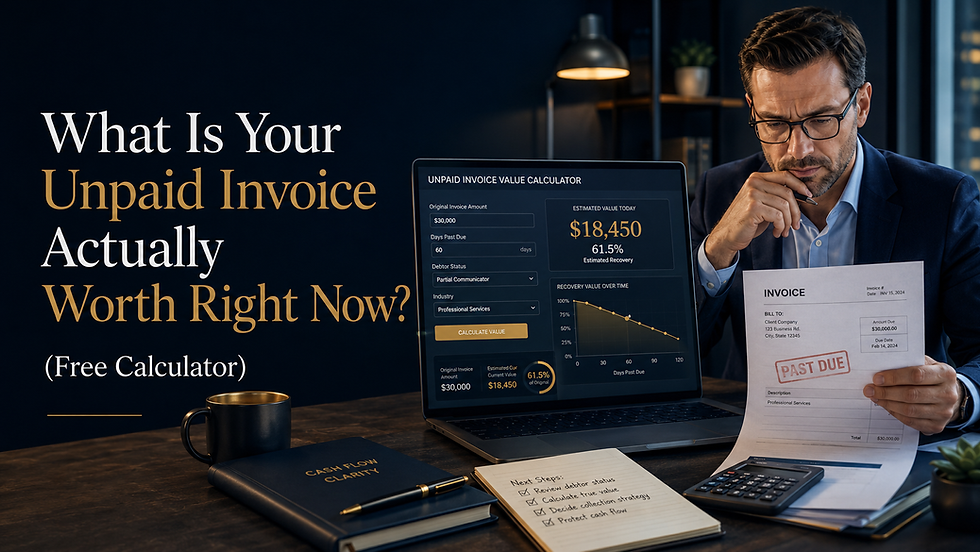
"How much of this am I actually going to get back?" is the question every business owner is really asking when they look at an aging report. Most of them answer it with a gut feeling — this customer seems fine, that one's gone quiet, this account is old but the amount is big enough to keep chasing.
None of that is wrong exactly. It's just not a real estimate, because it's missing half the picture.
Age matters, but age alone doesn't tell you much. Two invoices at 60 days past due can have completely different odds of getting paid — one where the customer has a signed contract on file and is still replying to emails, and one where the contact's gone silent and there's nothing in writing beyond an invoice. Same age. Very different reality.
We built a free tool that actually weighs both. Enter the balance and how many days it's been overdue, then answer three quick questions — do you have documentation, is the debtor still responsive, has anything been disputed — and it gives you a real likelihood estimate, not just an age-based guess, along with the dollar value that estimate represents.
Use this free calculator to see roughly how much of an overdue invoice is still recoverable — and what waiting longer could cost you.
A few things worth knowing about how to read it:
The three refine questions aren't decoration — they visibly move the number. Strong documentation adds to your odds. A debtor who's gone completely silent subtracts more than a debtor who's merely inconsistent. A formal, documented dispute drags the estimate down further than a vague one. You can watch the percentage shift in real time as you answer differently, which is the point — it's meant to show why two seemingly similar accounts can have very different odds, not just spit out one flat number.
It's still an estimate, not an appraisal. The baseline pattern (recoverability declining with account age) reflects commonly observed industry behavior, and the three refine factors adjust that baseline in a way that's directionally honest but not scientifically precise down to the decimal. Think of it like a home value estimator: genuinely useful for figuring out where you stand, not a substitute for someone actually looking at your specific account.
This is the same underlying pattern we wrote about in the hidden cost of waiting to collect a B2B debt — the tool just makes it interactive and lets you plug in your own numbers instead of reading about it in the abstract.
If you want the bigger-picture version of this — not one invoice, but your whole portfolio against real industry benchmarks — our accounts receivable benchmarking guide and Fair Capital's benchmarking data by industry are the next place to look.
And if the number this tool gives you is lower than you'd like, that's exactly the point where an actual account review is worth having. Request a free quote and we'll look at the real account — the documentation, the debtor, the history — not just an estimate, on a no-recovery, no-fee basis.


Comments